
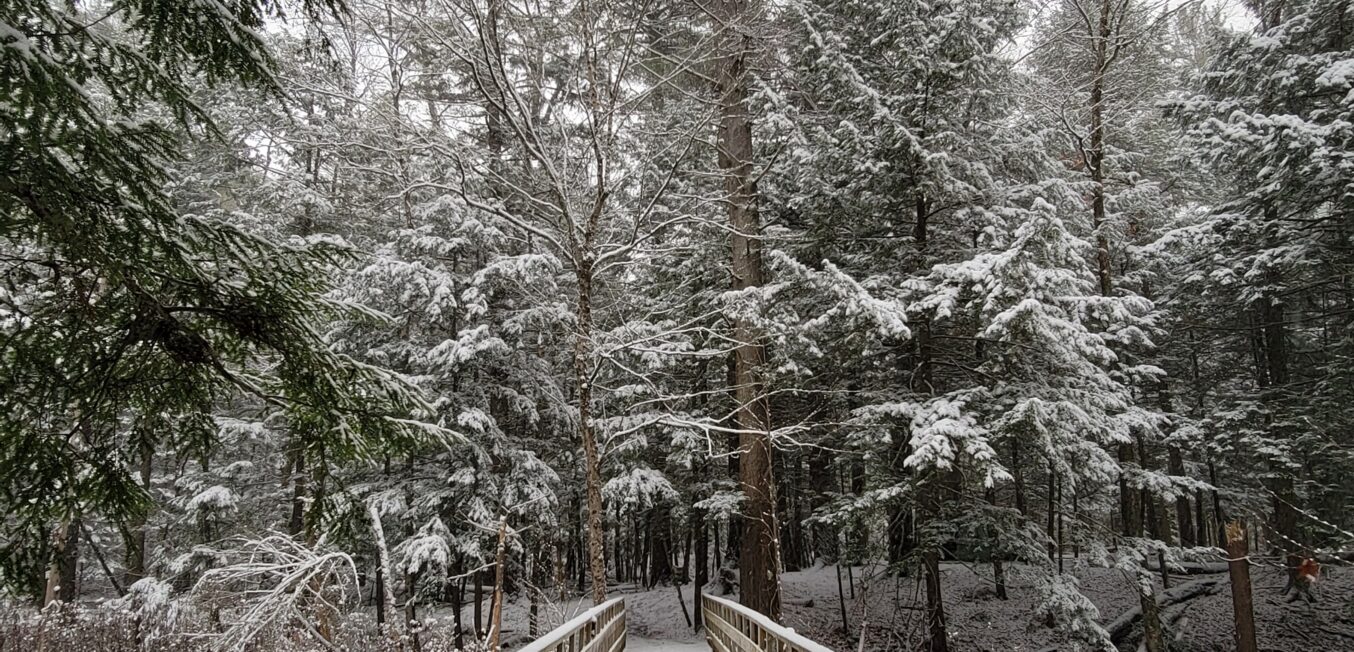
30 people joined us on Zoom for Forests & Forest Health with guest speaker Allison Winmill from Lallemand Plant Care. She began by explaining that Ontario has four main forest regions:
- Boreal Forests (northern conifers like spruce, fir and pine)
- Great Lakes-St. Lawrence (mixed pines, hemlock, maple, oak)
- Deciduous forest (hardwoods like maple, beech, oak in southwestern Ontario)
- Hudson Bay lowlands (tundra-like, sparse trees)
Simcoe County lies within the Great Lakes-St. Lawrence Forest Region. Allison then zeroed in on the biothreats that are pertinent to that forest environment. It is possible to have an entire presentation on any one of these biothreats, so the information was fairly high level.
Key Threats to Forests and Forest Health
Our forests face a growing number of stresses from invasive insects, fungal diseases, and other pests. Some have been present for decades, while others are newly emerging in our region. Early detection and reporting are critical to slowing their spread.
Emerald Ash Borer (EAB)
Emerald Ash Borer affects all native ash species. The larval stage is the most damaging, as larvae feed beneath the bark and disrupt the flow of water and nutrients within the tree. This insect is well recognized and established at this point. Infested trees may show thinning canopies, epicormic shoots along the trunk (epicormic means new shoots that sprout from dormant buds beneath the bark of trees and woody plants, typically triggered by stress, damage (fire, pruning), or increased light exposure), increased woodpecker activity, bark splitting, and distinctive “D”-shaped exit holes. EAB is now well established across Ontario, and large-scale ash mortality has already occurred.
Beech Bark Disease (BBD)
Beech Bark Disease affects American beech, an important mast tree whose nuts are a vital food source for many wildlife species. The disease results from a combination of an invasive insect (the beech scale) and fungal pathogens. The insect creates wounds in the bark, allowing fungi to enter and spread, which can ultimately kill the tree. Symptoms include roughened bark, cankers, and a characteristic reddish discoloration beneath the bark. Over time, infected trees weaken, decline, and may die.
Beech Leaf Disease (BLD)
Beech Leaf Disease is a newer and growing concern. It was identified in Simcoe County in 2023 and continues to spread. It shows up as dark bands on the Beech leaf. It is associated with a microscopic nematode that affects leaf development.
Although Beech Leaf Disease has already been identified in Simcoe County, it is not known to be widespread, and thus is important to report (see bottom of this writeup). The damage is caused by a foliar nematode and can affect beech trees of any age or condition and can cause mortality.
Spongy Moth (formerly Gypsy Moth)
Spongy moth has been present in Ontario for over 100 years, with populations rising and falling in cyclical outbreaks. While it prefers oak, it can feed on more than 300 tree and shrub species. Caterpillars are identifiable by five pairs of blue dots followed by six pairs of red dots along their backs. Heavy infestations can cause extensive defoliation, leaving trees stressed and more vulnerable to other pests and diseases.
Dutch Elm Disease
Dutch Elm Disease is a fungal disease spread by bark beetles and root grafts between trees. It famously decimated elm populations across North America. Symptoms include wilting, yellowing, and browning of leaves, often beginning at the top of the tree. While resistant elm varieties exist, the disease remains present on the landscape.
Oak Wilt (Report immediately if suspected)
Oak Wilt is a serious fungal disease that can cause rapid tree death, particularly in red oaks that is important to keep an eye out for and report (see below for reporting). It is a fungal disease. Symptoms include leaf bronzing, wilting, and drop, often starting at the leaf edges and moving inward. The disease spreads through root connections and insect vectors. Oak Wilt has been confirmed in parts of Ontario and is a high priority for monitoring and reporting. Death can unsue in as little as one year.
Hemlock Woolly Adelgid (HWA)
Hemlock Woolly Adelgid is an aphid-like insect that feeds on eastern hemlock, often killing trees within a few years of infestation. It is identified by small, white, cottony masses found on the undersides of hemlock needles at the base. HWA has been detected in southern Ontario, including the Toronto area, but has not yet been confirmed in Simcoe County. Early detection is essential.
Asian Long-horned Beetle (ALB)
Asian Long-horned Beetle has twice been ‘eradicated’ and is thought to be now (so if found, please report). It attacks a wide range of hardwood trees, including maple, birch, elm, and poplar. It bores deep into the heartwood, leaving large, round exit holes about the size of a dime. It can be confused with the native White-spotted Sawyer beetle, which is not harmful. The Asian Long-horned Beetle look for the characteristic white dot between the wing covers on the back of the WSS and not on the Asian Long-Horned Beetle. Careful comparison with reference images is necessary when reporting suspected sightings.
Spotted Lanternfly
Spotted Lanternfly has not been confirmed in Canada but is present in the northeastern United States, including Pennsylvania since 2014. It poses a major threat to fruit trees, grapevines, and hardwoods, making it especially concerning for agriculture and forestry. Because of its proximity, Ontario remains on high alert, and any suspected sightings should be reported immediately.
Allison then mentioned “best practice” with regard to firewood – it is so important to not transport firewood from one location to another as the wood may hold some form of one of these insects/diseases, and then be inserted into a new location. Resist the temptation to bring your firewood from one spot to a cottage or campsite.
Allison mentioned that if you have a concern about management of one of these entities, look them up on the webistes and find management strategy suggestions. For instance for oaks, one recommendation is to avoid pruning from April 1 to October 31, to avoid creating an entry point for the fungus. Also, good practice following a hike in the woods, is to lint roll clothing, and brush/scrape boots, wash your clothes post hike, and don’t move materials. If something looks suspicious, take a photo of it with something in the photo for scale, such as a dime.
Reporting & Monitoring
Allison then presented the four main websites that are helpful for monitoring the presence of threatening invasives, as well as strategies to deal with them, and how to report them.
- Invasive Species Centre (report a sighting) - invasivespeciescentre.ca
- University of Georgia, Centre for Invasive Species and Ecosystem Health (report a sighting) - eddmaps.org
- Canadian Food Inspection Agency - https://inspection.canada.ca/en/plant-health
- Ontario Ministry of Natural Resources Forest Health Update - https://www.ontario.ca/page/forest-health-conditions
